A Mathematical Proof of Teamwork
Dedicated to my dear friend Andrut.
I love mathematics. To me, it feels like a language of precision—a system so consistent and structured that it almost feels like a reflection of perfection itself. Everything in mathematics can be explored, proven, and understood through logic. It is not just abstract symbols on paper; it quietly shapes the way the world works.
Let me share a simple but interesting example of how mathematics appears in everyday thinking.
Most of us remember learning basic algebra in school, especially polynomial expansions like:
\[(a + b)^2 = a^2 + b^2 + 2ab\]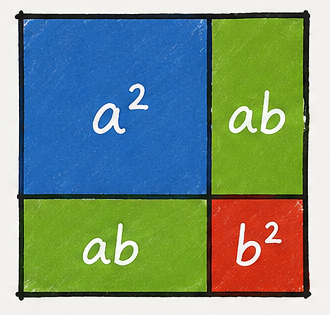
At first glance, it looks like a simple formula to memorize. But if you look at it more carefully, there is something meaningful hidden inside it—especially in the term $\mathbf{2ab}$.
Now imagine interpreting this in a real-world context.
Let’s say $a$ and $b$ represent two people working individually. If person $a$ works alone, their contribution is $a^2$. If person $b$ works alone, their contribution is $b^2$.
But when they work together, something interesting happens: the expression becomes $(a + b)^2$, and the extra term $2ab$ appears.
This extra term can be seen as the interaction effect — the benefit created when two people collaborate. It is not just $a$’s work plus $b$’s work; it includes the additional value generated through coordination, communication, and shared effort.
In this interpretation, the term $2ab$ represents how teamwork can amplify results. When two people work together effectively, their combined output is not merely additive—it can be significantly greater because of synergy.
But mathematics rarely offers only one sign. If $(a + b)^2$ describes what happens when two people reinforce each other, its mirror image describes what happens when they work against each other:
\[(a - b)^2 = a^2 + b^2 - 2ab\]Notice what stays the same and what changes. The individual squares, $a^2$ and $b^2$, are still there—each person still brings their own ability and effort. But the interaction term has flipped from $+2ab$ to $-2ab$.
In this reading, $-2ab$ is friction: duplicated effort, misaligned priorities, unclear communication, and the energy spent managing conflict instead of doing the work. Collaboration is not automatically additive. When two people pull in opposite directions, their combined output can be less than the sum of their individual parts.
So the lesson is not simply that teamwork is good. It is that the sign of the interaction is what matters. Two capable people who align multiply their effect; two equally capable people who pull apart quietly cancel it out. Mathematics does not promise that together is always better. It shows, with painful clarity, that together is always different—and the whole difference lives in the cross term.
Sometimes, mathematics does not just describe numbers. It gives us metaphors that help us understand life itself.